
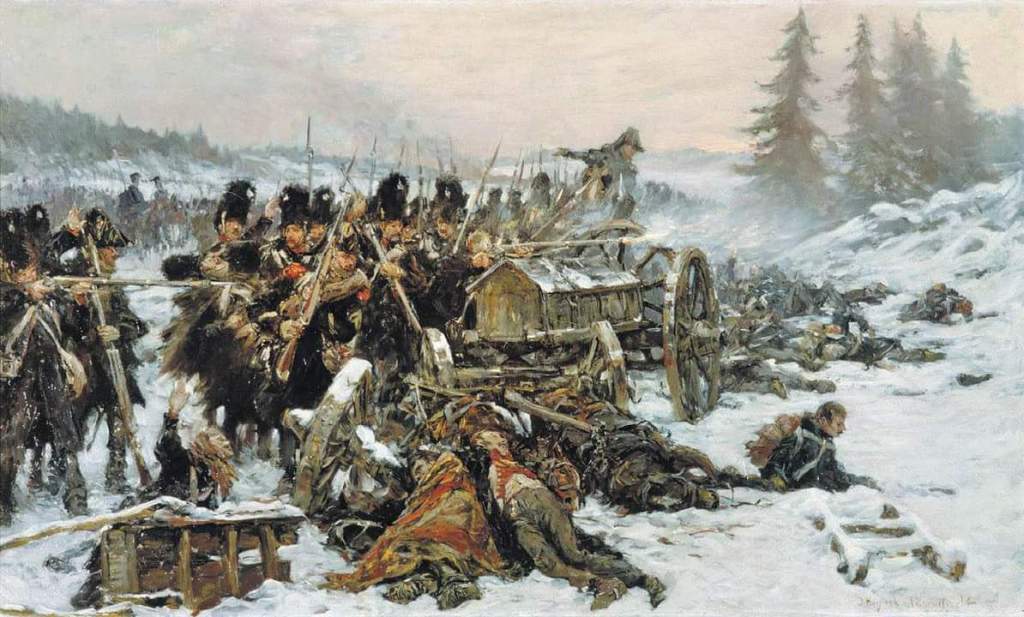
About a year ago I uncovered that one of my ancestors had served in Napoleon’s armies. That triggered my interest and I decided to search more systematically for information about him. But to my surprise, instead of finding out more about that one ancestor, I started finding more Napoleonic troops amongst my ancestors. Here a brief description of where I am at the moment in my search for the story of a seemingly remarkable collection of individuals some of whom were on the frontlines during a remarkable 2 years of European history, whilst others deserted within days.
Who is who?
Perhaps I should for now restrict myself to simply ‘listing’ who I have found so far. I will do so by using the names they were given in the French records that record their presence in the Grande Armee. These are of coursed ‘frenched‘ versions of their Dutch first names.

Jean Witte (*9/9/1788 in Deventer)
My 3-times Great-grandfather Jean Witte was the son of Peter Witte, grandson of the German immigrant Johannes Juergen Witte who had come to the Netherlands early in the 18th century as one of the “Hollandgaenger”, German seasonal workers from Lower Saxony and Westfalia who would seek employment in the economically thriving Dutch Republic. Johannes Juergen joined the States Army of the Republic, and so would his son Peter. Peter Witte served well over a decade and left the army after the disastrous effort by the Prince of Orange in the War of the First Coalition against revolutionary France. When his father quit the military in 1797, Jean

was already 6 years old. Six, you say? Wasn’t he 9 years old by then? Well, yes if you believe the French records, but not in reality. Jean Witte lied about his age (he essentially gave them his older sisters birthdate) when he joined the military forces of the french ‘Royaume d’ Hollande’ under Napoleon Bonaparte’s younger brother Louis Bonaparte as King Lodewijk I, in 1806. His audacity however paid off as he joined the Garde Royale d’ Hollande, and as part of that saw ‘action’ in the War of the 4th and the 5th coalitions. He did not participate in any of the major battles however as Louis’s forces were mostly active in the Weserland.
In 1810 the Kingdom of Holland was fully annexed into the 1st French Empire, Louis was exiled by his brother and the units of the Royal Guard were distributed across the various regiments of the Grande Armee. Jean Witte was incorporated in October 1810 into the 2nd regiment of Foot Grenadiers of the Imperial Guard. A fateful decision, because this meant that destiny had a date for him with Napoleon Bonaparte’s 1812 Invasion of Russia. Jean’s regiment would, on the retreat from Moscow, on Noverber 17th 1812, be fully annihilated in the Battle at Krasnoie. The final moments of the foot-grenadiers were captured by Jan Hoynck van Papendrecht in his painting as the image above this post.
The official French records indicate Jean was killed in action. However some time around early November 1813 he returned, alive, to Deventer. Just in time to witness and experience the final act of the Napoleonic presence in his hometown, which surrendered only on April 24th 1814, about 10 days after Napoleon’s abdication in Fontainebleau. But more about that another time.
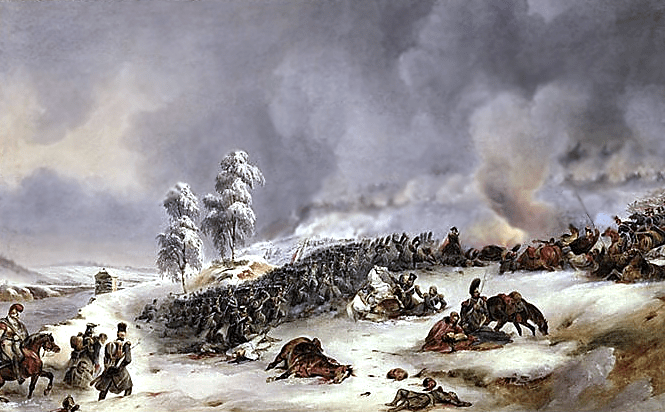
Stephane Koskamp (*2/8/1792 in Dinxperlo)
Stephane was the older brother of my 3-times Great-grandmother Aleida Koskamp. Stephane was conscripted into the Napoleonic army either in late 1810 or early 1811 and was allocated to the 33rd light infantry regiment. As fate would have it, the 33rd L.I. would also be part of the 1st Corps under Marshall Davout that would be part of the Invasion of Russia. I have not yet been able to see the french documentation about him, but from what I know he in all likelihood was taken prisoner of war between the 16th and 18th of November 1812, in the same battle at Krasnoi where the Dutch foot-grenadier regiment f the Imperial Guard was destroyed, the 33rd L.I. regiment was also decimated. Their last stand in a typical infantry-square formation, as defence against a cavalry charge, was depicted in a painting by Peter von Hess. Stephane would return home, many years later around 1818.

Évert Hoffs (*22/04/1792 in Doetinchem)
Evert was the younger brother of my 3-times Great-grandmother Anna Hoffs. He too was conscripted in late 1810 or early 1811 and, like Stephane, he was also drafted into the 33rd L.I. regiment. I hope to find out more about him when I finally get access to the records (which are not available online). But based on what I know now, I have reason to believe he did not make it back from Russia. Not only does Anna name a daughter and a son after him in 1814 and 1815, but the name Évert is only then starting to be passed down in my family on my mother’s side, down to my oldest brother.
Cousins in arms: Guillaume & Frederic Landzaat (*10/06/1785 & *12/03/1789 Utrecht)
Guillaume volunteered for service in May 1809, during the time of the reign of Louis Napoleon as King of Holland. Although the elder of the two, his younger cousin Frederic had already volunteered in November 1805, aged just 16 or 17 (there’s some unclarity regarding his birthdate) before that. Frederic started his career as a chasseur in the 2nd Chasseurs regiment, but in February 1807 he was absorbed into the Garde Royale d’ Hollande. Frederic became a grenadier in the same battalion and company as Jean Witte. In September of 1809 he was promoted to Corporal and, like Jean, was absorbed into the Garde Imperiale in October 1810. But this is where Jean’s and Frederic’s path separate. Late October 1810 Frederic leaves for Batavia, probably as part of a guard sent along with the new Governor of the Dutch East-Indies Jan Willem Janssens. When Jean prepares for the campaign in Russia, Frederic is engaged in the British invasion of Java. He probably ends up as PoW and returns to the Netherlands after the end of the Napoleonic era.
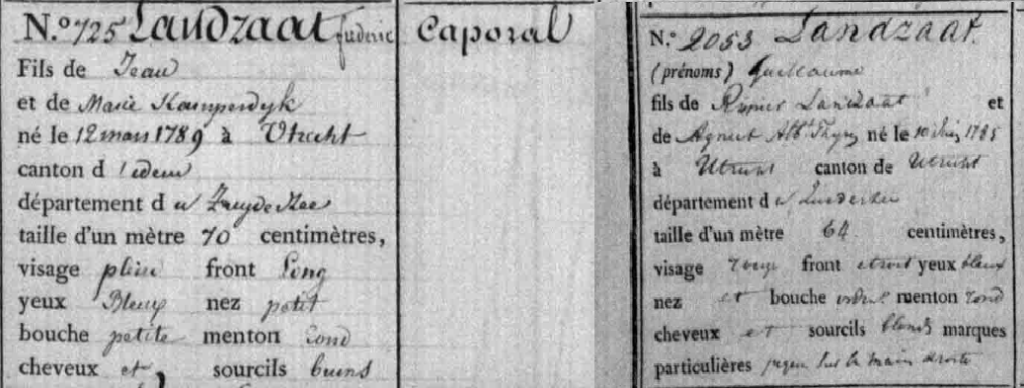
His cousin is less fortunate. Guillaume is deployed in the 124th line-infantry regiment in 1810, where in late 1810 he is injured in battle and passes away of his injuries in hospital in early 1811. The 124th would also be part of the Russian campaign, but by that time Guillaume had already passed away.
Cousins in Arms: Marcel and Jean van Gorkom (*24/04/1785 & *6/8/1793, Utrecht)
Guillaume and Frederik aren’t the only direct cousins that volunteered, another such pair are Marcel and Jean van Gorkom, both from Utrecht, both direct cousins, and my 6th cousins once removed. Marcel joins the armed forces of the Batavian republic in August 1803, barely 18, as a fusilier, and three years later he is added to the 124th line infantry regiment as a voltigeur, and he is active in all major campaigns of 1805 through to 1809. In late 1813 he deserts, and although there is no specific date mentioned in the archives it is most likely in November when 6th Coalition forces enter the Netherlands.

Marcel’s younger cousin Jean is only 16 when he volunteers and is assigned to the Velites de Garde Royal d’ Hollande in 1809. In 1811 these units are incorporated into the Pupilles de Garde of the Imperial Garde, and again two years later Jean moves to the 7th regiment of Tirailleurs de Garde Imperiale. It is in that role that he is involved in the 1813 campaign in Germany, and the battles of Luetzen and Bautzen. The last entry in his french records is that he is entered into hospital in late 1813. It is unclear to me whether Marcel and Jean survive.
Now, you might wonder: what is it with all these volunteers from Utrecht? Well, perhaps it has something to do with the central role of that city in the later 1780’s during the Batavian Revolt, the Dutch mini-precursor to the French Revolution. The Revolt was squashed by Prussian troops invited by Stadholder William of Orange, but Utrecht had been one of the main strongholds of the revolutionaries, many of whom fled to France in 1787.
Johannes Cornelis Vreeswijk (*20/11/1791 Utrecht)
Johannes Cornelis is the brother of my 4-times great grandmother Cornelia Johanna Vreeswijk. Simon is from my father’s side of the family, and I know very little about him. He was conscripted in the the 33rd light infantry regiment. I do know he survived whatever he got into with the 33rd, but unfortunately he was not to have a long life after the war. He passed away November 2th 1825
Simon Broekman (*25/11/1790, Utrecht)
Simon is my 2nd cousin 6 times removed, I still can’t quite believe how I have grown used to that kind of terminology. Anyway, Simon is also from my father’s side of the family and I know very little about him. He too was conscripted in the the 33rd light Infantry regiment. He had an ‘older’ brother also called Simon who died about 10 months before Simon was born. His 3 remaining, mostly younger, siblings seem to have done well and lived long lives with plenty of surviving kids. Yet, not one of them named after Simon. It seems fair, for the time being, to assume that Simon did not survive the annihilation of the 33rd LI regiment.
Arnold Koskamp (*4/12/1793 in Dinxperlo)
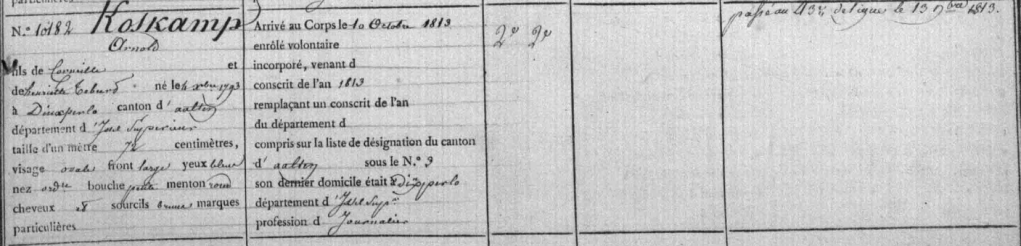
Arnaud was a full cousin of Stephane and Aleida. He was recruited into the 27th line infantry regiment as fusilier on October 10th 1813 as the War of the 6th Coalition raged when the UK and it’s allies realised the disaster of 1812 opened up Napoleon’s vulnerabilities. Arnaud was transferred to the 43rd line infantry regiment on 14th November 1813, and likely saw battle in the early skirmishes when the fighting resumed in late winter of 1813. He was injured on December 3rd 1813 but returned to service on March 1st 1814. The regiment is disbanded on March 31st 1814.
Bérend Wikkerink (*16/03/1790 in Dinxperlo)
is the brother of my 3-times Great-grandfather Wessel Wikkerink, who married Aleida Koskamp, Stehane’s sister. He was recruited in the 88e cohortes, for active duty within Imperial France. In 1813 these units were merged into new 135th to 156th line-regiments. Berend survived but I don’t yet have the records to be able to say precisely what has happened to him. All I know is that he does return to his family late. He starts a family only in 1818 and about 20 years later he, his wife and children emigrate to the United States where they settle as farmers in Wisconsin. The oldest daughter of Wessel Wikkerink and Aleida Koskamp joins Berend’s family, with her husband, a few years later.
Arnaud Rademaker (*12/01/1790 in Dinxperlo)
A full cousin to Wessel and his brother Berend Wikkerink, Arnaud is also conscripted into the 88e Cohortes. It seems he was deployed for guard-duty within the Netherlands, but I do not have the access to the records yet to confirm that. He is reported killed in Utrecht May 23rd 1813.
Dirk-Jean ter Horst (*2/12/1790 in Dinxperlo)

Dirk-Jean is a full cousin of my 3-times Great-grandfather Jan-Hendrik ter Horst. Dirk-Jean was recruited into the 126th line infantry regiment on March 5th 1812, transferred to the 13th line infantry regiment as a dragoon on April 15th 1812. Possibly participated in the Battle of Leipzig, the “Battle of the Nations”, and the final campaign in France during February-March 1814. My records of him are not yet complete, but what I know so far suggests he did not survive.

Lambert Heusinkveld (*23/03/1792 Varseveld)
was a full cousin of my times great-grandfather Hendrik-Jan Heusinkveld. Lambert was conscripted on April 12th 1813, as a replacement for a cousin, Gerrit-Willem Heusinkveld, as a grenadier in the 19th Line Infantry regiment. On September 30, 1813, he was hospitalised. He returned to his family probably some time in 1815.

Lambert Winkelhorst (*15/02/1790 Aalten)
is my 1st cousin 6 times removed, was conscripted early 1812 and served in the 126th Infantry of the Line. At the moment I do not have information yet about his whereabouts during the years 1812-1815 but it is possible he is involved in the Battle of the Berezina Crossing in late November 1812 where the 126th regiment is largely destroyed.

Deserting a lost cause
As the autumn of 1813 approached, the Battle of the Nations at Leipzig had gone awry the whole thing increasingly seemed a lost cause.
Christiaan Winkelhorst (*08/03/1792 Aalten)
Christiaan is a (2nd) cousin of Lambert. He is formally conscripted in 1812, on October 29th, 1813, he is incorporated into the 88th line infantry regiment, and on November 13th 1813 he is transferred to the 14th regiment of the line. He deserts his regiment on January 8th 1814, when Cossacks and regular Russian troops are already holding positions in the area where his family lives.
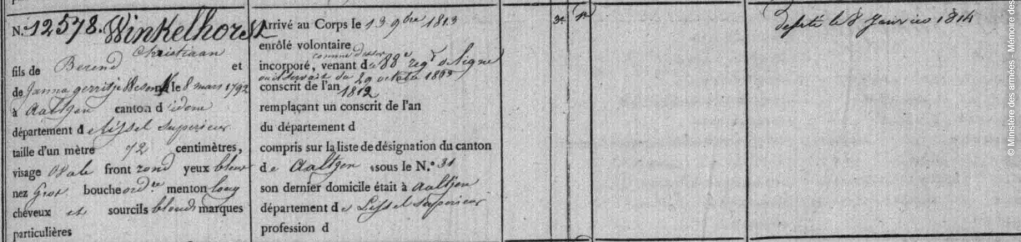
Gerard Rutgers (*09/11/1791 Varseveld)
Gerard, my 1st cousin 5 times removed, was conscripted into the Napoleonic army, allocated to the 124th regiment of the line, where he arrived on December 11th 1812. Not a particularly fortuitous moment in case one was looking for ‘glory’ as by that time any chance for that had been all but lost. No wonder then that at some point in 1813 Gerard decided to desert. Most likely he does so when Cossacks and Russian regular troop enter the eastern provinces of the Netherlands.
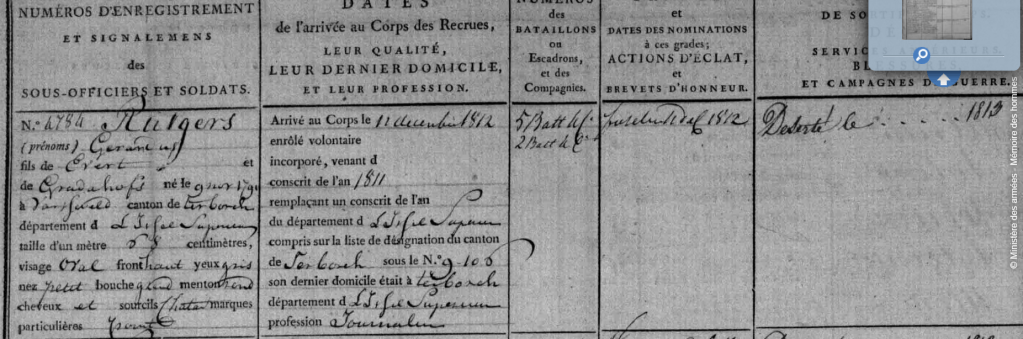
Willem Prinsen (*03/08/1792 Dinxperlo)
Willem is the grandfather of the wife of a grandchild of Stephane Koskamp’s sister, Aleida Koskamp. I know, it seemingly gets complicated, but really all these folks knew eachoter. Anyway, Willem is conscripted in the year 1812, and he reports in to his unit in the 124 infantry of the line regiment on October 21st, 1813. However his enthusiasm is extremely limited. He deserts his regiment on November the 3rd, 1813, i.e. about 2 weeks later.

Yet some remained at it
Now the above few may lead you to believe that 1813 was generally a year where these young men decided to abscond themselves from a near inevitable loss after the 1812 disaster in Russia. But not all.
Frederik Misset (*16/02/1787, Haarlem)
Is my 2nd cousin 5-times removed on my father’s side. He acts as a replacement for a conscript and joins the 25th line-infantry regiment om April 17th 1813, so he is quite late to the ‘game’.
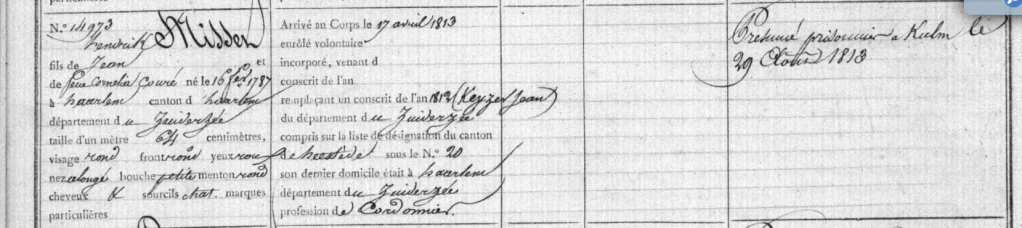
Frederik arrived at his designated regiment, the 25th Infantry of the Line, on April 17th 1813. Soon after his arrival they marched east. This regiment was part of the 1st corps in the War of the 6th coalition, commanded by General Dominique-Joseph René Vandamme.

The latter was, let’s say ‘a bit of a character’. Napoleon supposedly told Vandamme that “If I had two of you, the only solution would be to have one hang the other” and “If I were to launch a campaign against Lucifer in Hell, Vandamme would be at my back“. After Napoleon successfully defeated the 6th Coalition Allies at the Battle of Dresden (August 26-27, 1813), Vandamme’s 1st Corps was ordered to harass the retreating allies. On August the 29th Vandamme and his 34,000 troops smashed into the retreating Russians under Alexander Ivanovich Ostermann-Tolstoy, at Kulm, and a chaotic battle ensued. While the Russians held their positions with great difficulty that day, the next day brought relief as Austrians, Prussians and more Russians arrived from all sides, effectively cutting off Vandamme from any escape.
Close to 25,000 soldiers of the 1st Corps were killed or captured. Vandamme himself was captured, brought to Tzar Alexander I who accused him of being a plunderer and brigand, to which Vandamme responded with “I am neither a plunderer nor a brigand, but in any case, my contemporaries and history will not reproach me for having murdered my own father“. Frederik Misset was also made prisoner of war at Kulm, already on the 29th.
Why Frederik in the Dutch translation of these documents seems to go under the name Hendrik is anyone’s guess. But the handwriting of Imperial officials in 1813 wasn’t what it had once been. Also the date of the Battle of Kulm is messed up in this particular entry in this document. For the soldiers elsewhere on the page the French clerk used the right date. I guess it is safe to assume that Frederik didn’t actually fight a single-handed rear-guard battle for another 2 months.
Frederik survived the adventure and return home. Interestingly, after doing so he marries Cornelia Johanna Dovianus, who just happens to be Jean Witte‘s 2nd cousin. This is all the more eyebrow-raising as Frederik was born, and lives, rather far away from Cornelia. It is a small world on the Napoleonic battle fields.
Conclusion
So far I have identified 19 members of my ancestry that were active in the final years of the Napoleonic era. Most were all youngsters, between 19 and 22 when they were part of the wars of their days. Of a few I am yet unsure whether they survived or returned home, of others I know their fates. Some opted to emigrate, perhaps after the trauma of war, perhaps after the trauma of hunger that followed as a result of the potato blight some decades after their experiences at the front. A quiet echo of experiences the generation of my father and siblings also underwent in, and following, WW2. While most of them were conscripted, Jean Witte and the Landzaat cousins volunteered, while Hendrik Misset, Arnold Koskamp, Lambert Heusinkveld acted as a replacement for another conscript, the latter as a replacement for a cousin. Many of these 13 have known each other, but most likely not all of them. Oddly enough, five of whom it is most unlikely that family ties, or birthplace, would have allowed them to meet, did campaign together or share regiments, four of them did meet the ‘end’ of their road in the same battle on the same early morning of November 17th 1812.
I am unsure whether I have identified all of the Napoleonic soldiers in my ancestry yet, but I am already somewhat surprised about the sheer number of them. I hope that in 2024 I can dig into some of the French archives in Vincennes in Paris, to find out some more detail about some of them. For now, I will simply ‘salute’ them when watching Ridley Scott’s new film.


This work is licensed under a Creative Commons Attribution-NonCommercial-ShareAlike 4.0 International License.

 My Imaginary Numbers